
This product is sold brand new. A manufacturer warranty applies only when the manufacturer provides one for this item.
Return requests must be submitted within 14 days of delivery and approved by our RMA department before the item is shipped back. Non-defective returns may be subject to a minimum 25% restocking fee and return shipping charges. Unauthorized returns are not eligible for credit or refund. Read the full return policy.
Enter your ZIP during checkout to see the estimated shipping rate before payment.
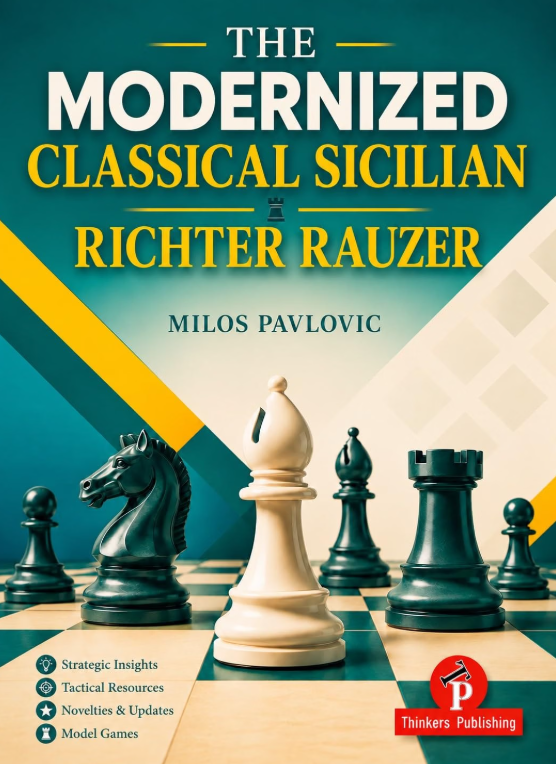
Describing the Classical Sicilian Defense as “solid” may seem almost contradictory, since the very nature of the Sicilian is dynamic, ambitious, and often extremely sharp. Yet among its many branches, the Richter-Rauzer Variation is arguably one of the most positionally oriented. Black frequently relies on the bishop pair, a resilient pawn structure, and active counterplay, with the thematic …b5 advance remaining an important part of Black’s strategy. Compared with highly theoretical systems such as the Najdorf or Dragon, the Rauzer is generally less forcing. This gives both players greater freedom to create imbalances and develop their own ideas without necessarily having to memorize an overwhelming number of concrete variations. The variation also has a fascinating historical pedigree.
During the famous 1972 World Championship match in Reykjavik, Boris Spassky employed the system twice against Bobby Fischer. The particular approach chosen by Spassky forms one of the central themes of this book. I have always had tremendous respect for Spassky and his universal understanding of chess, which was another reason for giving this variation a prominent place here.
At the same time, the Rauzer is far from being merely a historical opening. Several completely new ideas and variations have emerged in recent years, demonstrating that there is still considerable room for exploration. These modern developments are examined throughout the book. Another important direction covered is White’s choice of an f3-based pawn structure, rather than the more traditional and classical f4 setup. This changes the character of the position considerably and introduces different strategic plans, attacking patterns, and positional nuances for both sides.
Our pure Classical Sicilian therefore offers an attractive balance between classical positional understanding and modern dynamic chess. It allows players to fight for complex, unbalanced positions while retaining considerable scope for creativity—making it an excellent choice for those who want to understand their opening rather than simply memorize it.